A drawing tells us what to make. The application tells us what the magnet has to survive and how it must perform.

Where is the magnet used? Motor, sensor, coupling, holding device, medical, energy or other system.
Operating / peak temperature, fluids, humidity, corrosion, shock and vibration.
Flux density, force, torque, back-EMF, sensor threshold, field uniformity or air-gap target.
Envelope, air gap, magnet dimensions, working point, mechanical retention and assembly constraints.
Compare NdFeB / SmCo / Ferrite / AlNiCo / Flexible, then choose grade/coercivity class.
Axial, diametric, radial, multipole, skewed or array orientation.
Coating, adhesive, sleeve, overmold, housing and handling requirements.
Magnetic, dimensional, environmental and assembly verification before mass production.
A magnet in a closed magnetic circuit can tolerate heat differently from the same geometry in open circuit.
Thin magnets and low permeance coefficients can be more vulnerable to irreversible demagnetization.
Surface field, total flux and BH-curve measurements answer different questions; the method should be agreed before acceptance.
Customer and supplier tests should reproduce the same magnetic circuit or fixture when comparing high-temperature performance.
| Need | First materials to evaluate | Engineering note |
|---|---|---|
| Highest energy / smallest size | NdFeB | Check temperature/coercivity and coating |
| High temperature + strong coercivity | SmCo | Evaluate 1:5 vs 2:17 and brittleness |
| Lowest cost at large volume | Ferrite | Accept larger magnet volume; grinding for tight dimensions |
| Very low temperature drift | AlNiCo | Design the magnetic length/circuit to avoid self-demagnetization |
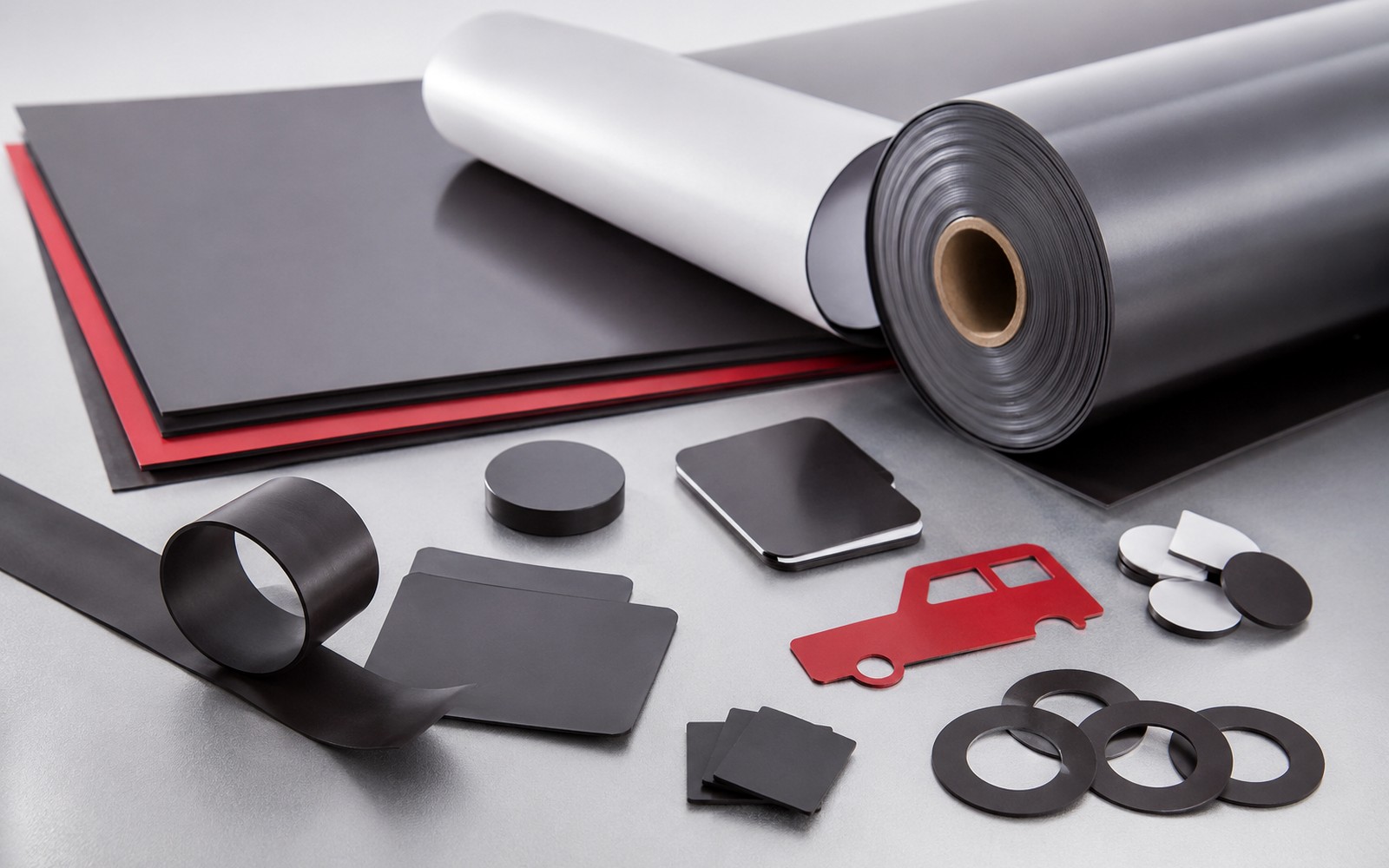
| Flexible sheet / strip / die-cut | Flexible ferrite | Binder/laminate controls temperature limit |
| Validated subsystem | Magnetic assembly | Review mechanical retention, magnetization, balance, runout, flux and validation together |
PDF, STEP, DXF, Excel or BOM can be uploaded in the RFQ.
Temperature, duty, environment, shock/vibration and expected service life.
Flux, field, torque, force, back-EMF or functional pass/fail target.
Prototype quantity, annual volume, sample target and SOP timing.
Critical dimensions, test method, sampling, PPAP/FAI or customer-specific documentation.
NDA can be arranged before sensitive drawings or specifications are exchanged.