Temperature map
Give the magnet temperature range, gradients, cycling rate and the allowable change in flux or sensitivity.
MAGNETIC MATERIALS
Cast and sintered magnets for stable flux and elevated-temperature applications.
Review My AlNiCo ApplicationCompare Cast and Sintered GradesAlNiCo combines useful temperature stability with specific magnetic-circuit requirements. We review alloy grade, geometry, opposing fields and calibration needs together, supporting applications where a defined and repeatable output matters.

FORMS & CONFIGURATIONS
Representative product forms. Final geometry, dimensions and material are confirmed against your drawing.
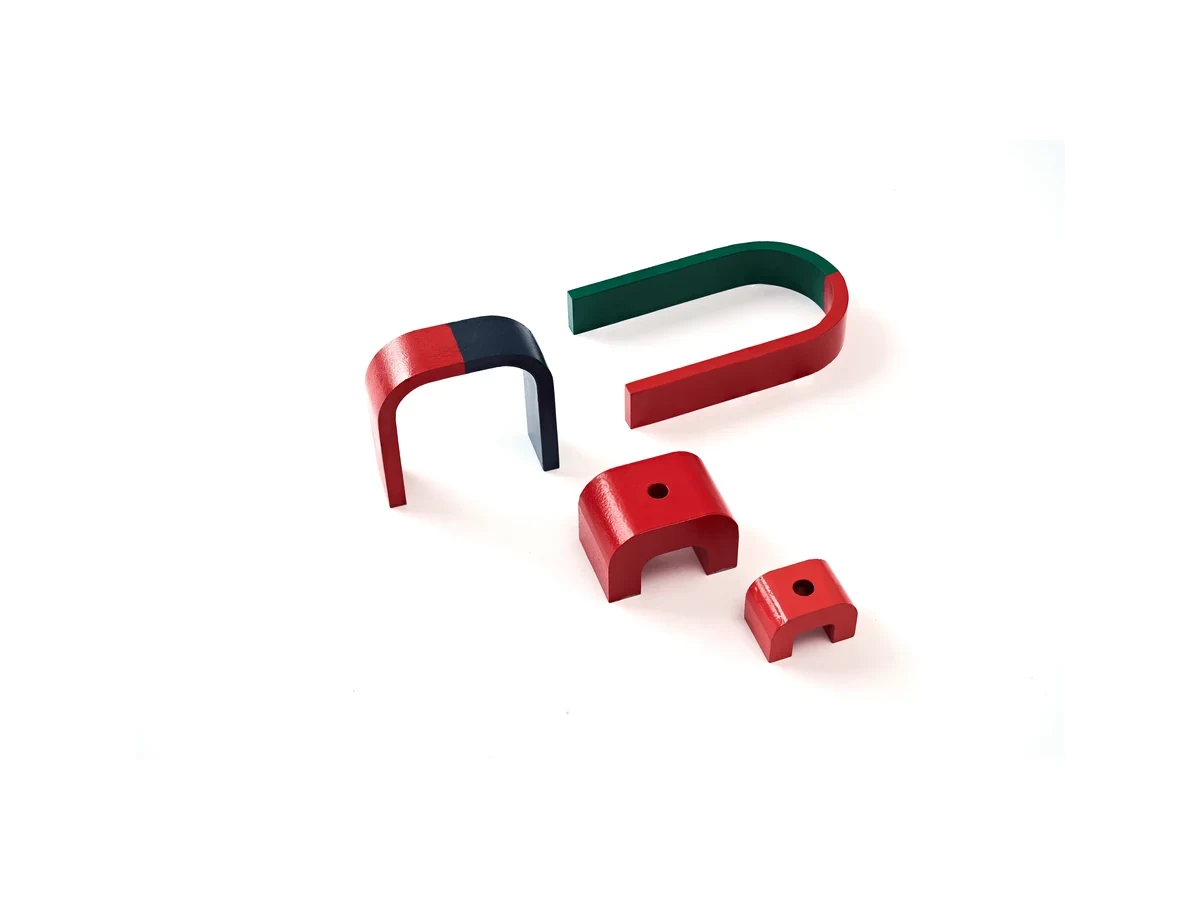
Complex geometry produced by the cast route
Review This Form
Small parts with tighter dimensional control
Review This Form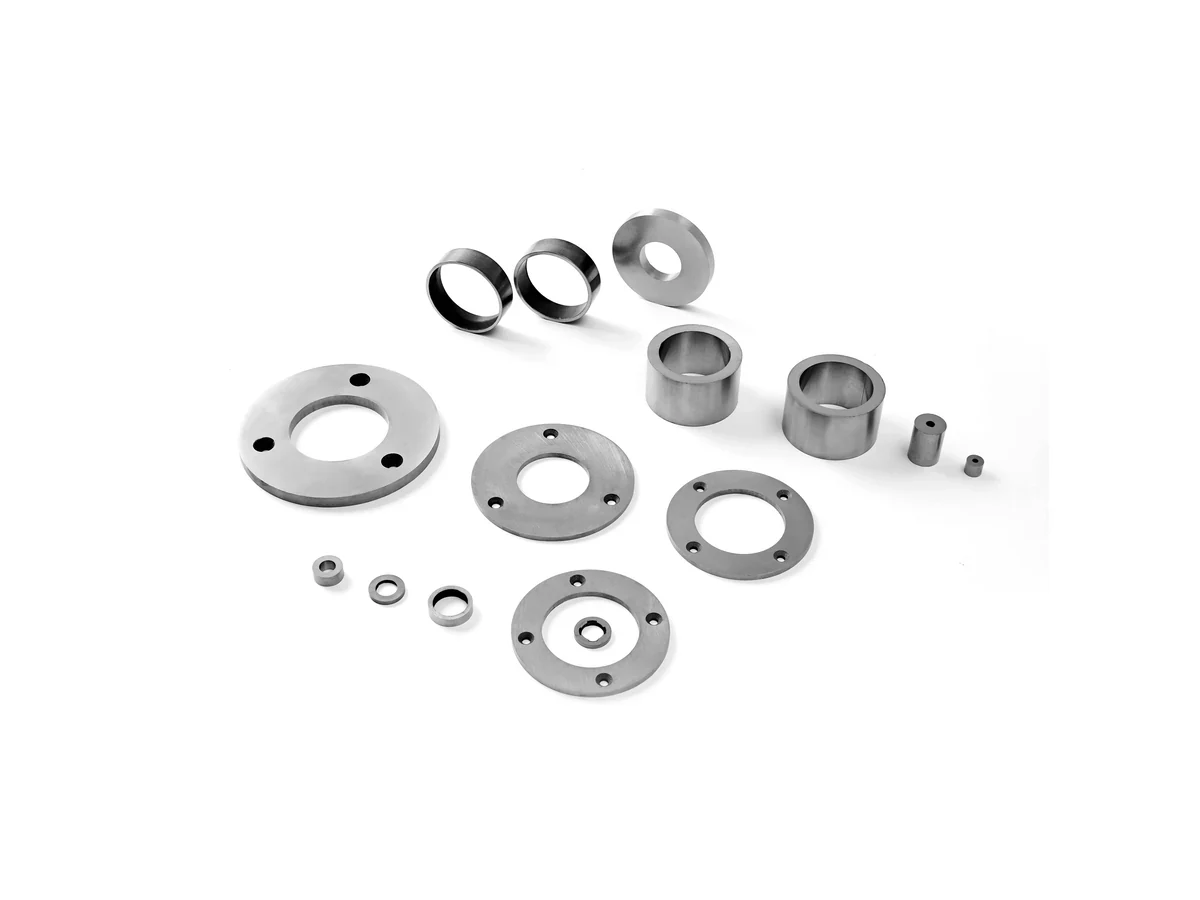
Ring geometry for instrumentation
Review This Form
Segment geometry for legacy magnetic circuits
Review This FormDESIGN & SELECTION
Define orientation and functional surfaces
Review working gap and reverse fields
Confirm magnetization and handling plan
Select a category to see the inputs to confirm.
Review This ConfigurationSelection identifies the review scope. Materials, ratings and acceptance criteria remain subject to engineering confirmation.
ENGINEERING REVIEW
A clear specification connects magnetic performance with a practical manufacturing route.
Give the magnet temperature range, gradients, cycling rate and the allowable change in flux or sensitivity.
Provide opposing field, nearby steel, armature position and the worst-case open-circuit or fault condition.
State whether the part is cast or sintered, along with geometry, machining allowance, surface finish and appearance limits.
For sensors and instruments, define the output window, magnet-to-sensor distance, matching requirement and calibration method.
MATERIAL REFERENCE
No matching results. Clear the filter or ask for selection help.
| Grade / Route | Br | Hc | Hci | (BH)max | Max Operating Temp* | |
|---|---|---|---|---|---|---|
| Alnico 2 (Sintered) | 7.0 kG / 0.70 T | 500 Oe / 40 kA/m | ≥540 Oe / 43 kA/m | 1.5 MGOe / 12 kJ/m³ | 450°C | Material Datasheet |
| Alnico 5 (Sintered) | 11.0 / 1.10 | 600 / 48 | ≥600 / 48 | 4.25 / 34 | 450°C | Material Datasheet |
| Alnico 8 (Sintered) | 8.8 / 0.88 | 1530 / 121 | ≥1600 / 127 | 5.25 / 42 | 450°C | Material Datasheet |
| Alnico 5 (Cast) | 12.2 / 1.22 | 600 / 48 | 630 / 50 | 5.0 / 40 | 500°C | Material Datasheet |
| Alnico 5B (Cast) | 12.2 / 1.22 | 650 / 52 | 660 / 53 | 5.5 / 44 | 500°C | Material Datasheet |
| Alnico 5DG (Cast) | 12.5 / 1.25 | 690 / 55 | 700 / 56 | 6.5 / 52 | 500°C | Material Datasheet |
| Alnico 5-7 (Cast) | 13.0 / 1.30 | 700 / 56 | 740 / 59 | 7.5 / 60 | 525°C | Material Datasheet |
| Alnico 8-HC (Cast) | 7.0 / 0.70 | 1750 / 139 | 1750 / 139 | 4.5 / 36 | 525°C | Material Datasheet |
| Alnico 8 (Cast) | 8.2 / 0.82 | 1500 / 119 | 1600 / 127 | 5.0 / 40 | 525°C | Material Datasheet |
| Alnico 8B (Cast) | 8.8 / 0.88 | 1500 / 119 | 1650 / 131 | 5.5 / 44 | 525°C | Material Datasheet |
| Alnico 8C (Cast) | 9.0 / 0.90 | 1380 / 110 | 1440 / 115 | 7.5 / 60 | 525°C | Material Datasheet |
| Alnico 9 (Cast) | 10.5 / 1.05 | 1410 / 112 | 1440 / 139 | 9.0 / 72 | 525°C | Material Datasheet |
Reference values support initial selection; the approved drawing and agreed specification govern supply.
Grade PDF links open a dedicated grade file. Material Datasheet links open the general material reference.
No matching results. Clear the filter or ask for selection help.
| Application | Typical Spec | Why this material |
|---|---|---|
| Precision instruments | Alnico 2 / 5 | Very low flux drift over temperature |
| Watt-hour meters | Alnico 5 | Long-term stable reference field |
| Reed switch actuation | Alnico 3 / 5 | Stable actuation across temperature |
| Radar / TWT / instruments | Alnico 8 / 9 | High-temperature stability |
| Educational / scientific | Alnico 2 | Classic rods / horseshoe forms |
Reference values support initial selection; the approved drawing and agreed specification govern supply.
No matching results. Clear the filter or ask for selection help.
| Route | Strength | Tolerance / shape logic | Typical use |
|---|---|---|---|
| Cast | Higher energy and complex castable forms | Larger geometry; grinding on functional surfaces | Horseshoes, meters, sensors, instruments |
| Sintered | Fine grain and repeatability for small parts | Smaller precision components | Miniature sensors, magnetic circuits, instruments |
Reference values support initial selection; the approved drawing and agreed specification govern supply.
No matching results. Clear the filter or ask for selection help.
| Property | Sintered | Cast |
|---|---|---|
| Vickers hardness | ~440 | 440–620 |
| Density | 6.8–7.0 g/cm³ | 6.9–7.3 g/cm³ |
| Curie temperature | 810–860°C | 740–860°C |
| Specific resistance | 50–70 μΩ·cm | 45–75 μΩ·cm |
| Thermal expansion | 11.0–12.4 ×10⁻⁶/°C | 11.0–13.0 ×10⁻⁶/°C |
| Reversible temperature coefficient Br | ≈ −0.02 to −0.03%/°C | ≈ −0.02 to −0.03%/°C |
Reference values support initial selection; the approved drawing and agreed specification govern supply.
No matching results. Clear the filter or ask for selection help.
| Route | Typical Tolerance | Notes |
|---|---|---|
| As-cast | ±0.3–0.5 mm | Economical near-net shape |
| Ground | ±0.05 mm | Pole and mounting faces |
| Sintered | ±0.05 mm | Small precision parts |
| Machining | Grinding-focused | Hard/brittle alloy; functional surfaces are normally ground |
Reference values support initial selection; the approved drawing and agreed specification govern supply.
QUALITY & RELEASE
Verification follows the component’s function and the agreed inspection plan.
Verify the magnetic output over the agreed temperature profile rather than accepting room-temperature data alone.
Test the worst-case opposing field or assembly condition and record the retained performance after exposure.
Inspect cast or sintered features against the drawing, including machining datum, porosity or visual limits where applicable.
For matched sets, define the measurement fixture, temperature point, sorting band and traceability record.
PRODUCT QUESTIONS
AlNiCo can be attractive when very stable temperature behavior, specific cast geometries or a legacy magnetic circuit are important. SmCo may be preferred when higher coercivity or a more compact design is needed.
It can, but the complete magnetic circuit must be evaluated because AlNiCo has relatively low coercivity. Nearby steel and opposing fields can change the working point.
The manufacturing route affects achievable geometry, dimensional control, surface finish and cost. The suitable route should be selected against the drawing and volume.
CONTINUE EXPLORING

High magnetic energy for compact motors, sensors and precision assemblies.
Explore Product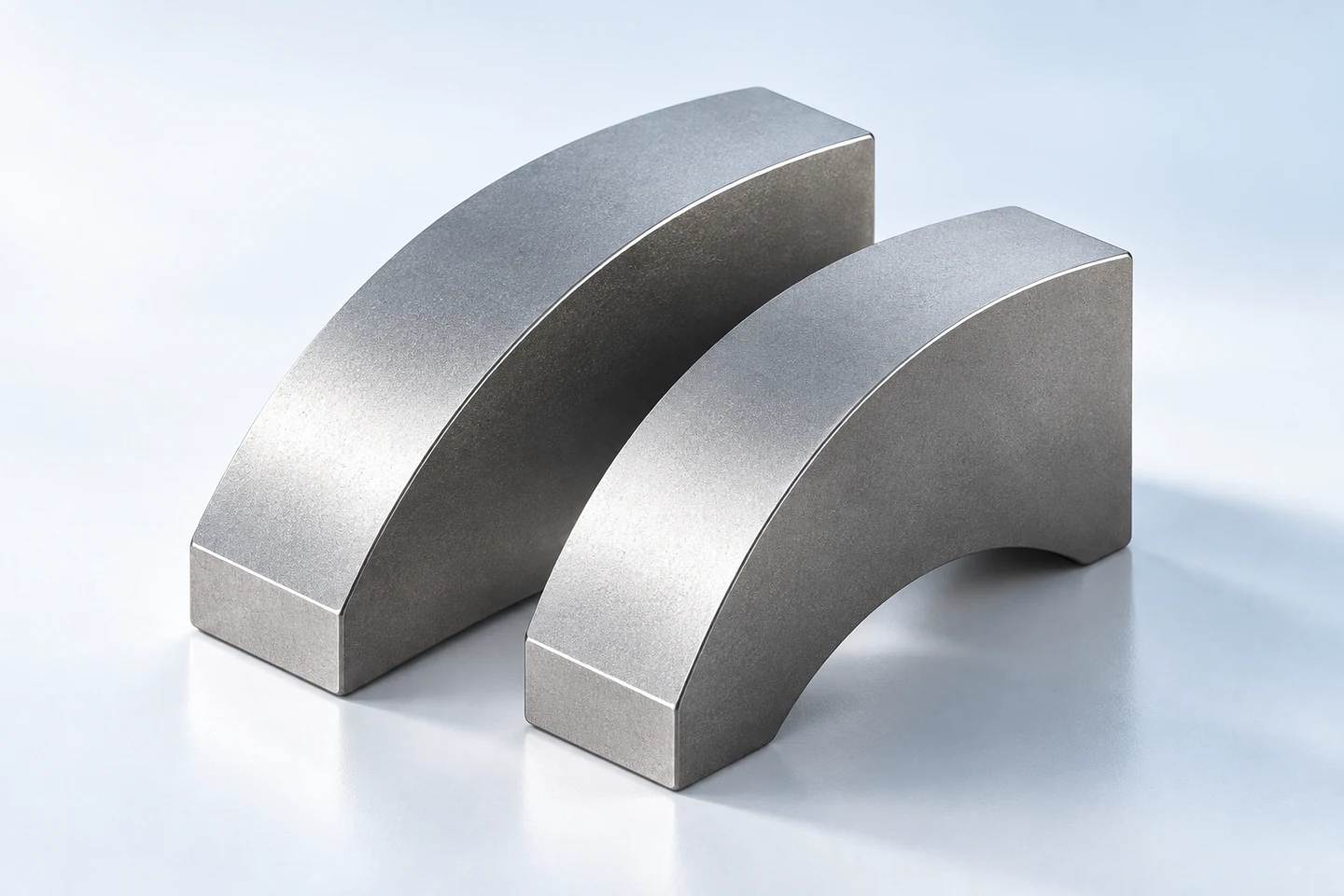
Temperature-stable rare-earth magnets for demanding operating environments.
Explore Product
Ceramic magnets for motors, magnetic circuits and volume production.
Explore ProductFROM YOUR DRAWING TO PRODUCTION
Share your drawing. Define the next step.
Start a Technical Review