Available envelope
Share the maximum diameter, arc length, radial thickness and air gap. Ferrite selection often succeeds or fails on available magnetic-circuit volume.
MAGNETIC MATERIALS
Ceramic magnets for motors, magnetic circuits and volume production.
Request a Ferrite QuoteCompare Ferrite GradesFor many motors and industrial components, the right answer is a well-engineered ferrite magnet. We review magnetic output, available space, geometry and process tolerances to develop a practical route for repeat production.

FORMS & CONFIGURATIONS
Representative product forms. Final geometry, dimensions and material are confirmed against your drawing.

A selection of ferrite blocks, rings, discs and shaped components.
Review This Form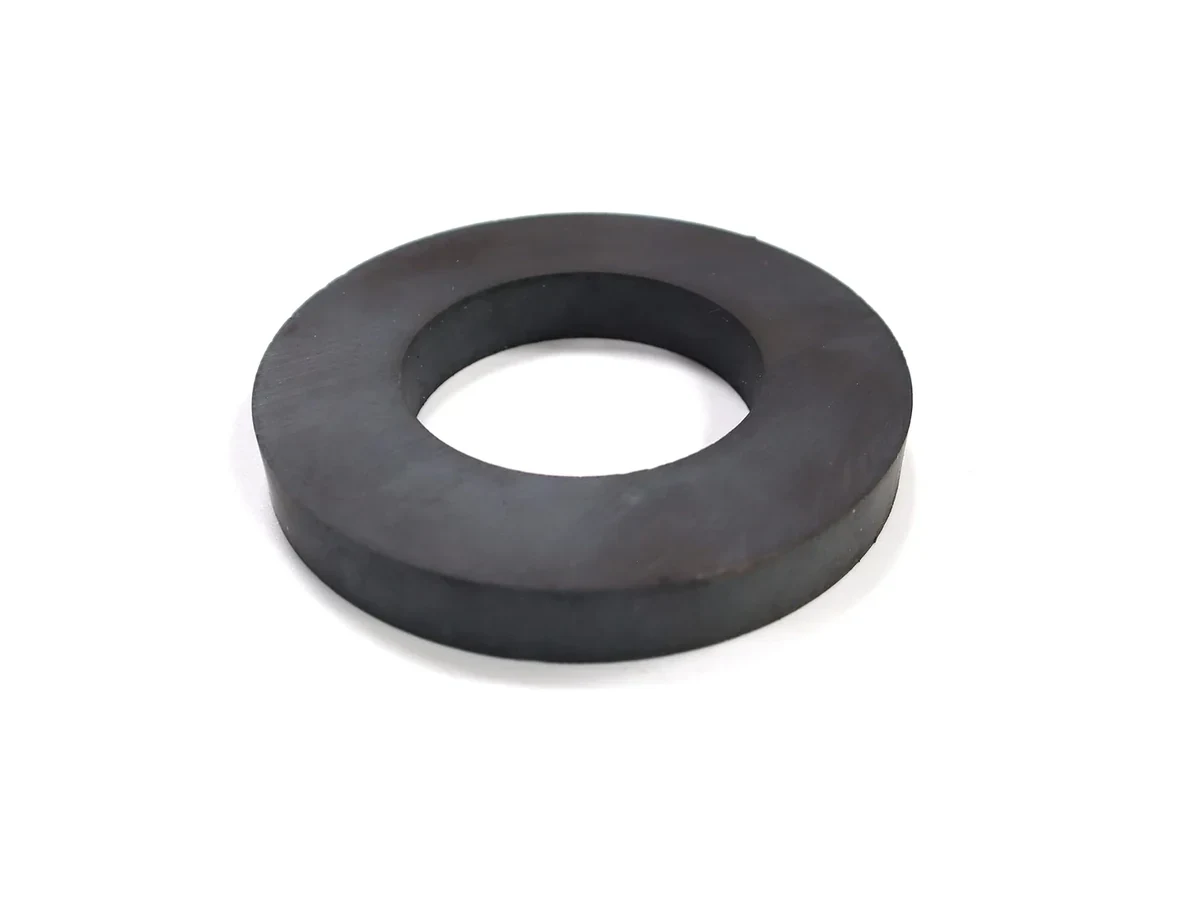
Ring geometry for speakers and sensors
Review This Form
Block geometry for holders and separators
Review This Form
Round geometry for general industrial use
Review This FormDESIGN & SELECTION
Radius, arc angle, wall and axial length
Preferred orientation and pole pattern
Ground faces, dimensional limits and edge condition
ENGINEERING REVIEW
A clear specification connects magnetic performance with a practical manufacturing route.
Share the maximum diameter, arc length, radial thickness and air gap. Ferrite selection often succeeds or fails on available magnetic-circuit volume.
Provide pull force, flux density, torque or speaker sensitivity target together with the test fixture and measurement position.
Describe the housing, adhesive, press fit, shock, vibration and edge-clearance requirements for the ceramic part.
State annual demand, launch quantity and expected design life. Tooling and cavity decisions should be evaluated with the forecast.
MATERIAL REFERENCE
No matching results. Clear the filter or ask for selection help.
| Grade | Br mT (kGs) | Hcb kA/m (kOe) | Hcj kA/m (kOe) | (BH)max kJ/m³ (MGOe) | |
|---|---|---|---|---|---|
| Y8T | 200-235 (2.0-2.35) | 125-160 (1.57-2.01) | 210-280 (2.64-3.52) | 6.5-9.5 (0.8-1.2) | Material Datasheet |
| Y10T | 200-235 (2.0-2.35) | 128-160 (1.61-2.01) | 210-280 (2.64-3.52) | 6.4-9.6 (0.8-1.2) | Material Datasheet |
| Y20 | 320-380 (3.2-3.8) | 135-190 (1.70-2.39) | 140-195 (1.76-2.45) | 18.0-22.0 (2.3-2.8) | Material Datasheet |
| Y22H | 310-360 (3.1-3.6) | 220-250 (2.76-3.14) | 280-320 (3.52-4.02) | 20.0-24.0 (2.5-3.0) | Material Datasheet |
| Y23 | 320-370 (3.2-3.7) | 170-190 (2.14-2.39) | 190-230 (2.39-2.89) | 20.0-25.5 (2.5-3.2) | Material Datasheet |
| Y25 | 360-400 (3.6-4.0) | 135-170 (1.70-2.14) | 140-200 (1.76-2.51) | 22.5-28.0 (2.8-3.5) | Material Datasheet |
| Y26H | 360-390 (3.6-3.9) | 220-250 (2.76-3.14) | 225-255 (2.83-3.20) | 23.0-28.0 (2.9-3.5) | Material Datasheet |
| Y26H-1 | 360-390 (3.6-3.9) | 200-250 (2.51-3.14) | 225-255 (2.83-3.20) | 23.0-28.0 (2.9-3.5) | Material Datasheet |
| Y26H-2 | 360-380 (3.6-3.8) | 263-288 (3.30-3.62) | 318-350 (4.00-4.40) | 24.0-28.0 (3.0-3.5) | Material Datasheet |
| Y27H | 370-400 (3.7-4.0) | 205-250 (2.58-3.14) | 210-255 (2.64-3.20) | 25.0-29.0 (3.1-3.6) | Material Datasheet |
| Y28 | 370-400 (3.7-4.0) | 175-210 (2.20-2.64) | 180-220 (2.26-2.76) | 26.0-30.0 (3.3-3.8) | Material Datasheet |
| Y28H-1 | 380-400 (3.8-4.0) | 240-260 (3.02-3.27) | 250-280 (3.14-3.52) | 27.0-30.0 (3.4-3.8) | Material Datasheet |
| Y28H-2 | 360-380 (3.6-3.8) | 271-295 (3.41-3.71) | 382-405 (4.80-5.09) | 26.0-30.0 (3.3-3.8) | Material Datasheet |
| Y30 | 370-400 (3.7-4.0) | 175-210 (2.20-2.64) | 180-220 (2.26-2.76) | 26.0-30.0 (3.3-3.8) | Material Datasheet |
| Y30BH | 380-390 (3.8-3.9) | 223-235 (2.80-2.95) | 231-245 (2.90-3.08) | 27.0-30.0 (3.4-3.8) | Material Datasheet |
| Y30H-1 | 380-400 (3.8-4.0) | 230-275 (2.89-3.46) | 235-290 (2.95-3.64) | 27.0-32.0 (3.4-4.0) | Material Datasheet |
| Y30H-2 | 395-415 (3.95-4.15) | 275-300 (3.46-3.77) | 310-335 (3.90-4.21) | 27.0-32.5 (3.4-4.1) | Material Datasheet |
| Y32 | 400-420 (4.0-4.2) | 160-190 (2.01-2.39) | 165-195 (2.07-2.45) | 30.0-33.5 (3.8-4.2) | Material Datasheet |
| Y32H-1 | 400-420 (4.0-4.2) | 190-230 (2.39-2.89) | 230-250 (2.89-3.14) | 31.5-35.0 (4.0-4.4) | Material Datasheet |
| Y40 | 440-460 (4.4-4.6) | 290-330 (3.64-4.15) | 280-330 (3.52-4.15) | ~38-42 (~4.8-5.3) | Material Datasheet |
Reference values support initial selection; the approved drawing and agreed specification govern supply.
Grade PDF links open a dedicated grade file. Material Datasheet links open the general material reference.
No matching results. Clear the filter or ask for selection help.
| Application | Typical Spec | Why this material |
|---|---|---|
| DC / appliance motors | Y30 / Y30BH | Low cost and robust high-volume performance |
| Loudspeakers | Y25 / Y30 | Large magnet volume at economical cost |
| Magnetic separators | Y40 anisotropic | Higher ferrite energy for large field structures |
| Automotive sensing / small motors | Y30BH | Temperature-stable and corrosion-resistant |
| Consumer / crafts | Y10T isotropic | Low-cost geometry with flexible magnetization direction |
Reference values support initial selection; the approved drawing and agreed specification govern supply.
No matching results. Clear the filter or ask for selection help.
| Type | Orientation | Relative performance | Magnetization flexibility | Best fit |
|---|---|---|---|---|
| Isotropic | No preferred particle orientation | Lower | Can be magnetized in multiple directions | Cost-critical, multipole, consumer applications |
| Anisotropic | Particles aligned during pressing | Higher | Preferred direction fixed by manufacturing | Motors, speakers, separators |
| Wet-pressed anisotropic | Field-oriented slurry pressing | Highest mainstream ferrite performance | Preferred direction fixed | Higher-performance motor segments / rings |
Reference values support initial selection; the approved drawing and agreed specification govern supply.
No matching results. Clear the filter or ask for selection help.
| Characteristic | Symbol / Unit | Reference Value |
|---|---|---|
| Density | g/cc | 4.9–5.1 |
| Vickers hardness | Hv | 400–700 |
| Compression strength | N/mm² | 680–720 |
| Specific heat capacity | J/kg·°C | 795–855 |
| Electrical resistivity | μΩ·cm | ~1 × 10¹⁰ |
| Curie temperature | °C | ~450 |
| Rev. temp. coeff. Br | %/°C | ~−0.2 |
| Rev. temp. coeff. Hci | %/°C | ~+0.27 |
Reference values support initial selection; the approved drawing and agreed specification govern supply.
QUALITY & RELEASE
Verification follows the component’s function and the agreed inspection plan.
Agree on the property and fixture used for acceptance. For motor arcs, include pole orientation, matching and air-gap conditions.
Set critical dimensions, arc angle, flatness, edge condition and visual limits for chips or cracks.
Validate adhesive or mechanical retention under the actual vibration, temperature and shock profile.
Track material grade, cavity or tool identification, magnetizing setup and sampling plan across production lots.
PRODUCT QUESTIONS
Ferrite has a lower maximum energy product, so the magnetic circuit may need more volume to reach the same air-gap performance. The final trade-off depends on geometry and system design.
Ferrite is a ceramic material and is generally corrosion resistant without a metallic coating. The housing, adhesive and exposed surface still need to be reviewed for the actual environment.
Yes. Ferrite arcs are widely used in cost-sensitive motor designs when the available volume and required torque or speed are compatible with the material's magnetic performance.
CONTINUE EXPLORING

High magnetic energy for compact motors, sensors and precision assemblies.
Explore Product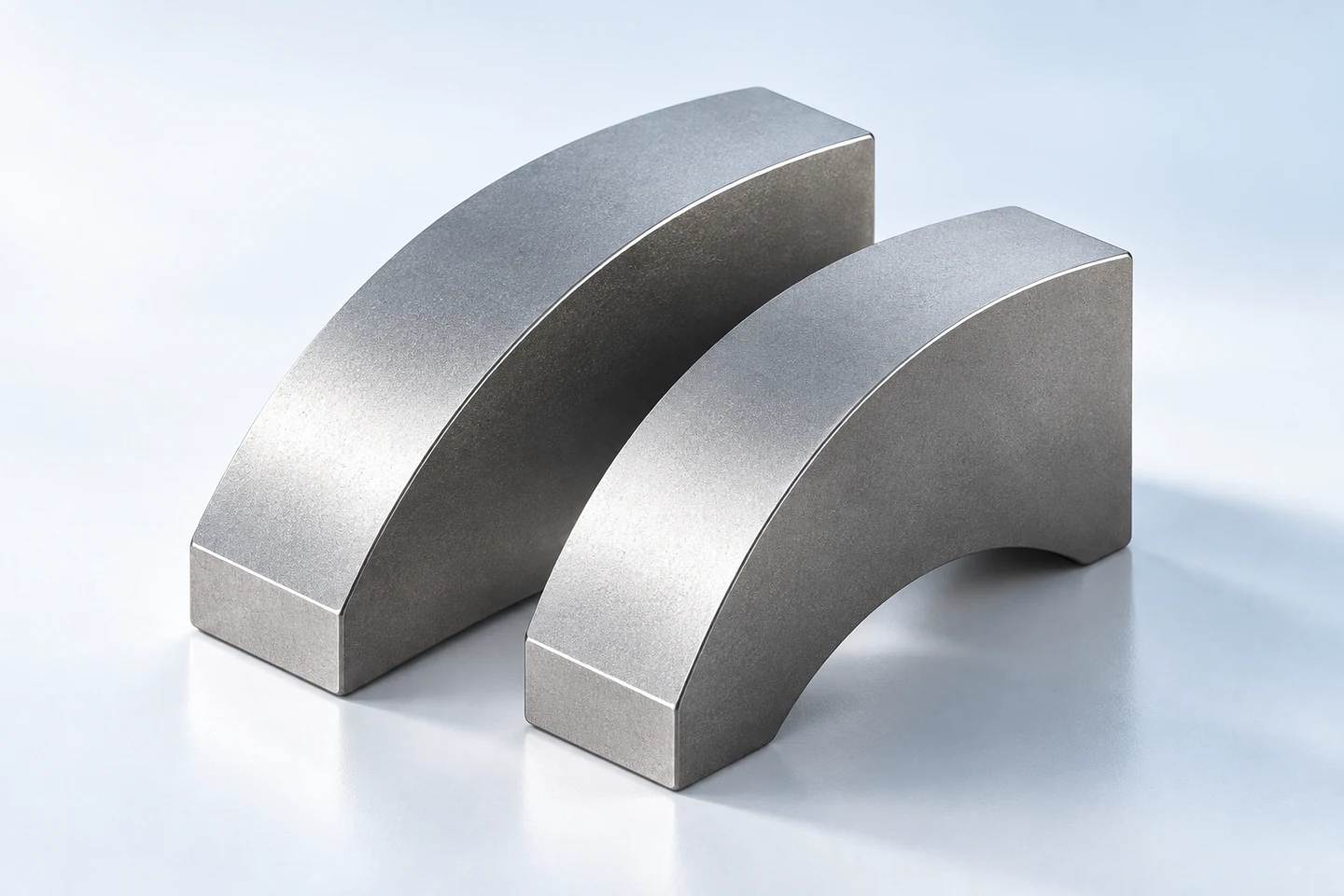
Temperature-stable rare-earth magnets for demanding operating environments.
Explore Product
Cast and sintered magnets for stable flux and elevated-temperature applications.
Explore ProductFROM YOUR DRAWING TO PRODUCTION
Share your drawing. Define the next step.
Start a Technical Review