Magnet temperature
Give the actual magnet body temperature, thermal gradient and duration. Separate continuous duty from short peak exposure.
MAGNETIC MATERIALS
Temperature-stable rare-earth magnets for demanding operating environments.
Request a SmCo ReviewCompare SmCo GradesWhen temperature and magnetic stability drive the specification, SmCo deserves careful consideration. We connect material selection with thermal exposure, demagnetizing conditions, mechanical support and the inspection evidence your application requires.
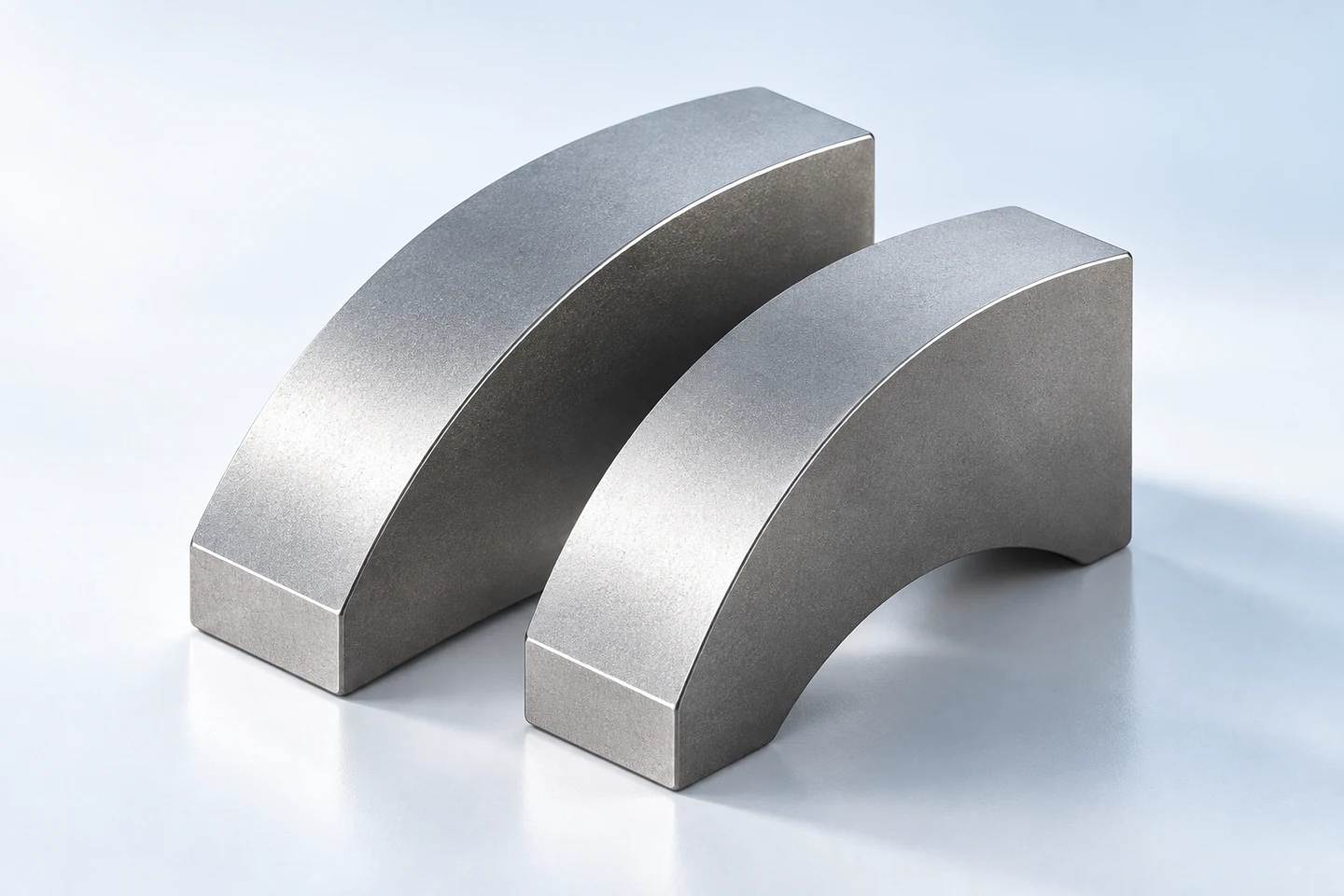
FORMS & CONFIGURATIONS
Representative product forms. Final geometry, dimensions and material are confirmed against your drawing.

Rectangular geometry, coating-free in most designs
Review This Form
Annular geometry for sensors and instruments
Review This Form
Blocks, rings, discs and arc segments for different magnetic circuits.
Review This FormDESIGN & SELECTION
Working point, temperature range and reverse fields
Ground surfaces, fits and edge allowance
Confirm 1:5 or 2:17 with the approved grade data
ENGINEERING REVIEW
A clear specification connects magnetic performance with a practical manufacturing route.
Give the actual magnet body temperature, thermal gradient and duration. Separate continuous duty from short peak exposure.
Describe impact, vibration, clamping, adhesive cure and insertion loads. SmCo parts should not be treated like ductile steel components.
State the allowable flux change, opposing field and temperature coefficient target so 1:5 and 2:17 options can be compared fairly.
Specify edge protection, pole orientation, keep-away distances, magnetized or unmagnetized shipment and any air-freight constraints.
MATERIAL REFERENCE
No matching results. Clear the filter or ask for selection help.
| Grade | Br mT (kGs) | Hcb kA/m (kOe) | Hcj kA/m (kOe) | (BH)max kJ/m³ (MGOe) | αBr %/°C | βHcj %/°C | |
|---|---|---|---|---|---|---|---|
| S10H | 580-710 (5.8-7.1) | ≥422 (≥5.3) | ≥1990 (≥25) | 63-95 (8-12) | 0.03 | 0.2 | Material Datasheet |
| S12H | 650-760 (6.5-7.6) | ≥478 (≥6.0) | ≥1990 (≥25) | 79-111 (10-14) | 0.03 | 0.2 | Material Datasheet |
| S14H | 710-830 (7.1-8.3) | ≥525 (≥6.6) | ≥1990 (≥25) | 95-127 (12-16) | 0.03 | 0.2 | Material Datasheet |
| S16H | 790-860 (7.9-8.6) | ≥589 (≥7.4) | ≥1990 (≥25) | 119-143 (15-18) | 0.03 | 0.2 | Material Datasheet |
| S18H | 830-890 (8.3-8.9) | ≥605 (≥7.6) | ≥1990 (≥25) | 135-159 (17-20) | 0.03 | 0.2 | Material Datasheet |
| S20H | 870-930 (8.7-9.3) | ≥653 (≥8.2) | ≥1990 (≥25) | 151-175 (19-22) | 0.03 | 0.2 | Material Datasheet |
| S22H | 910-980 (9.1-9.8) | ≥693 (≥8.7) | ≥1990 (≥25) | 159-183 (20-23) | 0.03 | 0.2 | Grade PDF |
| S24H | 960-1030 (9.6-10.3) | ≥724 (≥9.1) | ≥1990 (≥25) | 175-199 (22-25) | 0.03 | 0.2 | Grade PDF |
| S26H | 1010-1060 (10.1-10.6) | ≥733 (≥9.2) | ≥1990 (≥25) | 191-215 (24-27) | 0.03 | 0.2 | Grade PDF |
| S28H | 1040-1090 (10.4-10.9) | ≥749 (≥9.4) | ≥1990 (≥25) | 207-231 (26-29) | 0.03 | 0.2 | Grade PDF |
| S30H | 1080-1110 (10.8-11.1) | ≥773 (≥9.7) | ≥1990 (≥25) | 222-247 (28-31) | 0.035 | 0.2 | Grade PDF |
| S32H | 1120-1160 (11.2-11.6) | ≥812 (≥10.2) | ≥1990 (≥25) | 239-263 (30-33) | 0.038 | 0.2 | Grade PDF |
| S34H | 1150-1180 (11.5-11.8) | ≥835 (≥10.5) | ≥1990 (≥25) | 247-270 (31-34) | 0.04 | 0.25 | Material Datasheet |
| S35H | 1170-1200 (11.7-12.0) | ≥860 (≥10.8) | ≥1990 (≥25) | 255-278 (32-35) | 0.04 | 0.25 | Material Datasheet |
| S10 | 580-710 (5.8-7.1) | ≥422 (≥5.3) | ≥1592 (≥20) | 63-95 (8-12) | 0.03 | 0.2 | Material Datasheet |
| S12 | 650-760 (6.5-7.6) | ≥478 (≥6.0) | ≥1592 (≥20) | 79-111 (10-14) | 0.03 | 0.2 | Material Datasheet |
| S14 | 710-830 (7.1-8.3) | ≥525 (≥6.6) | ≥1592 (≥20) | 95-127 (12-16) | 0.03 | 0.2 | Material Datasheet |
| S16 | 790-860 (7.9-8.6) | ≥589 (≥7.4) | ≥1592 (≥20) | 119-143 (15-18) | 0.03 | 0.2 | Material Datasheet |
| S18 | 830-890 (8.3-8.9) | ≥605 (≥7.6) | ≥1592 (≥20) | 135-159 (17-20) | 0.03 | 0.2 | Material Datasheet |
| S20 | 870-930 (8.7-9.3) | ≥653 (≥8.2) | ≥1592 (≥20) | 151-175 (19-22) | 0.03 | 0.2 | Material Datasheet |
| S22 | 910-980 (9.1-9.8) | ≥693 (≥8.7) | ≥1592 (≥20) | 159-183 (20-23) | 0.03 | 0.2 | Material Datasheet |
| S24 | 960-1030 (9.6-10.3) | ≥724 (≥9.1) | ≥1592 (≥20) | 175-199 (22-25) | 0.03 | 0.2 | Material Datasheet |
| S26 | 1010-1060 (10.1-10.6) | ≥733 (≥9.2) | ≥1592 (≥20) | 191-215 (24-27) | 0.03 | 0.2 | Material Datasheet |
| S28 | 1040-1090 (10.4-10.9) | ≥749 (≥9.4) | ≥1592 (≥20) | 207-231 (26-29) | 0.03 | 0.2 | Material Datasheet |
| S30 | 1080-1110 (10.8-11.1) | ≥773 (≥9.7) | ≥1592 (≥20) | 222-247 (28-31) | 0.035 | 0.2 | Material Datasheet |
| S32 | 1100-1130 (11.0-11.3) | ≥804 (≥10.1) | ≥1592 (≥20) | 231-255 (29-32) | 0.038 | 0.2 | Material Datasheet |
| S33 | 1120-1160 (11.2-11.6) | ≥812 (≥10.2) | ≥1592 (≥20) | 239-263 (30-33) | 0.038 | 0.2 | Material Datasheet |
| S34 | 1150-1180 (11.5-11.8) | ≥835 (≥10.5) | ≥1592 (≥20) | 247-270 (31-34) | 0.04 | 0.25 | Material Datasheet |
| S35 | 1170-1200 (11.7-12.0) | ≥860 (≥10.8) | ≥1592 (≥20) | 255-278 (32-35) | 0.04 | 0.25 | Material Datasheet |
| S24M | 960-1030 (9.6-10.3) | 597-756 (7.5-9.5) | 796-1273 (10-16) | 175-199 (22-25) | 0.03 | 0.2 | Material Datasheet |
| S26M | 1010-1060 (10.1-10.6) | 597-820 (7.5-10.3) | 796-1273 (10-16) | 191-215 (24-27) | 0.03 | 0.2 | Grade PDF |
| S28M | 1040-1090 (10.4-10.9) | 621-836 (7.8-10.5) | 796-1273 (10-16) | 207-231 (26-29) | 0.03 | 0.2 | Grade PDF |
| S30M | 1080-1110 (10.8-11.1) | 621-836 (7.8-10.5) | 796-1273 (10-16) | 222-247 (28-31) | 0.035 | 0.2 | Grade PDF |
| S32M | 1110-1150 (11.1-11.5) | 717-844 (9.0-10.6) | 796-1273 (10-16) | 239-263 (30-33) | 0.038 | 0.2 | Grade PDF |
| S24L | 960-1030 (9.6-10.3) | 438-716 (5.5-9) | 478-796 (6-10) | 175-199 (22-25) | 0.03 | 0.2 | Material Datasheet |
| S26L | 1010-1060 (10.1-10.6) | 438-716 (5.5-9) | 478-796 (6-10) | 191-215 (24-27) | 0.03 | 0.2 | Material Datasheet |
| S28L | 1040-1090 (10.4-10.9) | 438-716 (5.5-9) | 478-796 (6-10) | 207-231 (26-29) | 0.03 | 0.2 | Material Datasheet |
| S30L | 1080-1120 (10.8-11.2) | 438-757 (5.5-9.5) | 478-796 (6-10) | 222-247 (28-31) | 0.035 | 0.2 | Material Datasheet |
| S32L | 1110-1150 (11.1-11.5) | 438-757 (5.5-9.5) | 478-796 (6-10) | 231-255 (29-32) | 0.038 | 0.2 | Material Datasheet |
| HTS20H | 870-930 (8.7-9.3) | ≥653 (≥8.2) | ≥1990 (≥25) | 151-175 (19-22) | 0.05 | 0.2 | Material Datasheet |
| HTS22H | 910-980 (9.1-9.8) | ≥693 (≥8.7) | ≥1990 (≥25) | 159-183 (20-23) | 0.05 | 0.2 | Grade PDF |
| HTS24H | 960-1030 (9.6-10.3) | ≥724 (≥9.1) | ≥1990 (≥25) | 175-199 (22-25) | 0.05 | 0.2 | Grade PDF |
| LTS14 | 730-800 (7.3-8.0) | ≥565 (≥7.1) | ≥1592 (≥20) | 103-127 (13-16) | 0.005–0.01 | 0.3 | Material Datasheet |
| LTS16 | 790-860 (7.9-8.6) | ≥613 (≥7.7) | ≥1592 (≥20) | 119-143 (15-18) | 0.01–0.015 | 0.3 | Material Datasheet |
| LTS18 | 830-890 (8.3-8.9) | ≥645 (≥8.1) | ≥1592 (≥20) | 135-159 (17-20) | 0.015–0.02 | 0.3 | Material Datasheet |
| LTS20 | 870-930 (8.7-9.3) | ≥653 (≥8.2) | ≥1592 (≥20) | 151-175 (19-22) | 0.02–0.025 | 0.3 | Material Datasheet |
| PS16H | 790-860 (7.9-8.6) | ≥605 (≥7.6) | ≥1990 (≥25) | 119-143 (15-18) | 0.05 | 0.3 | Material Datasheet |
| PS18H | 840-910 (8.4-9.1) | ≥645 (≥8.1) | ≥1990 (≥25) | 135-159 (17-20) | 0.05 | 0.3 | Material Datasheet |
| PS20H | 870-930 (8.7-9.3) | ≥653 (≥8.2) | ≥1990 (≥25) | 151-175 (19-22) | 0.05 | 0.3 | Material Datasheet |
| PS22H | 910-980 (9.1-9.8) | ≥693 (≥8.7) | ≥1990 (≥25) | 159-183 (20-23) | 0.05 | 0.3 | Material Datasheet |
| PS24H | 950-1010 (9.5-10.1) | ≥717 (≥9.0) | ≥1990 (≥25) | 175-199 (22-25) | 0.05 | 0.3 | Material Datasheet |
Reference values support initial selection; the approved drawing and agreed specification govern supply.
Grade PDF links open a dedicated grade file. Material Datasheet links open the general material reference. Series filters follow the source grade names; confirm the 1:5 or 2:17 system against the approved material specification.
No matching results. Clear the filter or ask for selection help.
| Application | Typical Spec | Why this material |
|---|---|---|
| High-temperature motors / actuators | SmCo 2:17 S24H–S30H | Stable flux and high coercivity at elevated temperature |
| Automotive sensors | S22H / S24H | Temperature stability and corrosion resistance |
| Downhole / harsh industrial | HTS series | High-temperature margin and chemical resistance |
| Microwave / instrumentation | SmCo 1:5 | High coercivity and predictable magnetic behavior |
| Medical / precision equipment | SmCo 2:17 | Stable output without relying on an external corrosion coating |
Reference values support initial selection; the approved drawing and agreed specification govern supply.
No matching results. Clear the filter or ask for selection help.
| Family | Energy / coercivity character | Temperature behavior | Processing note | Typical use |
|---|---|---|---|---|
| SmCo₅ (1:5) | Lower energy, high coercivity | Excellent | Fine/brittle; grinding only | Small parts, sensors, microwave devices |
| Sm₂Co₁₇ (2:17) | Higher energy product | Excellent to extreme-temperature classes | Grinding only; edge protection important | Motors, aerospace/industrial actuators, oil & gas |
| HTS 2:17 | Application-specific high-temperature family | Up to ~350°C class where validated | Test condition must be defined | Downhole, high-temperature actuation |
Reference values support initial selection; the approved drawing and agreed specification govern supply.
No matching results. Clear the filter or ask for selection help.
| Characteristic | SmCo 1:5 | SmCo 2:17 |
|---|---|---|
| Typical use | Small / complex, high-coercivity parts | Higher-energy, high-temperature applications |
| Energy product | Lower to medium | Higher |
| Temperature coefficient | Excellent | Excellent / typically better |
| Coercivity | Very high | High to very high |
| Manufacturing note | Fine-grain / brittle | Brittle; grinding only |
Reference values support initial selection; the approved drawing and agreed specification govern supply.
No matching results. Clear the filter or ask for selection help.
| Process | Typical Tolerance | Notes |
|---|---|---|
| As-sintered | ±0.1 mm | Non-critical faces |
| Ground | ±0.05 mm | Standard mating dimensions |
| Precision ground | ±0.02 mm | Locating / press-fit dimensions |
| Parallelism / perpendicularity | Per drawing | DFM confirmation |
Reference values support initial selection; the approved drawing and agreed specification govern supply.
QUALITY & RELEASE
Verification follows the component’s function and the agreed inspection plan.
Define the temperature cycle, dwell time, stabilization method and the magnetic property to be rechecked after exposure.
Inspect chips, cracks, edge damage and fit condition using agreed visual and dimensional criteria before assembly.
Use a controlled fixture and consistent measurement position when verifying flux, field strength or matched sets.
Tie grade, lot, heat treatment route, inspection results and packing identification to the same batch record.
PRODUCT QUESTIONS
SmCo is typically considered when temperature capability, coercivity, corrosion resistance or long-term stability justify its higher cost and more brittle handling characteristics.
Many SmCo designs can be evaluated without a coating, but the final decision still depends on the environment, surface handling, cleanliness and assembly process.
Machining strategy should be defined before production. Because SmCo is brittle and magnetic dust must be controlled, most precision processing and inspection planning is completed before final magnetization.
CONTINUE EXPLORING

High magnetic energy for compact motors, sensors and precision assemblies.
Explore Product
Ceramic magnets for motors, magnetic circuits and volume production.
Explore Product
Cast and sintered magnets for stable flux and elevated-temperature applications.
Explore ProductFROM YOUR DRAWING TO PRODUCTION
Share your drawing. Define the next step.
Start a Technical Review